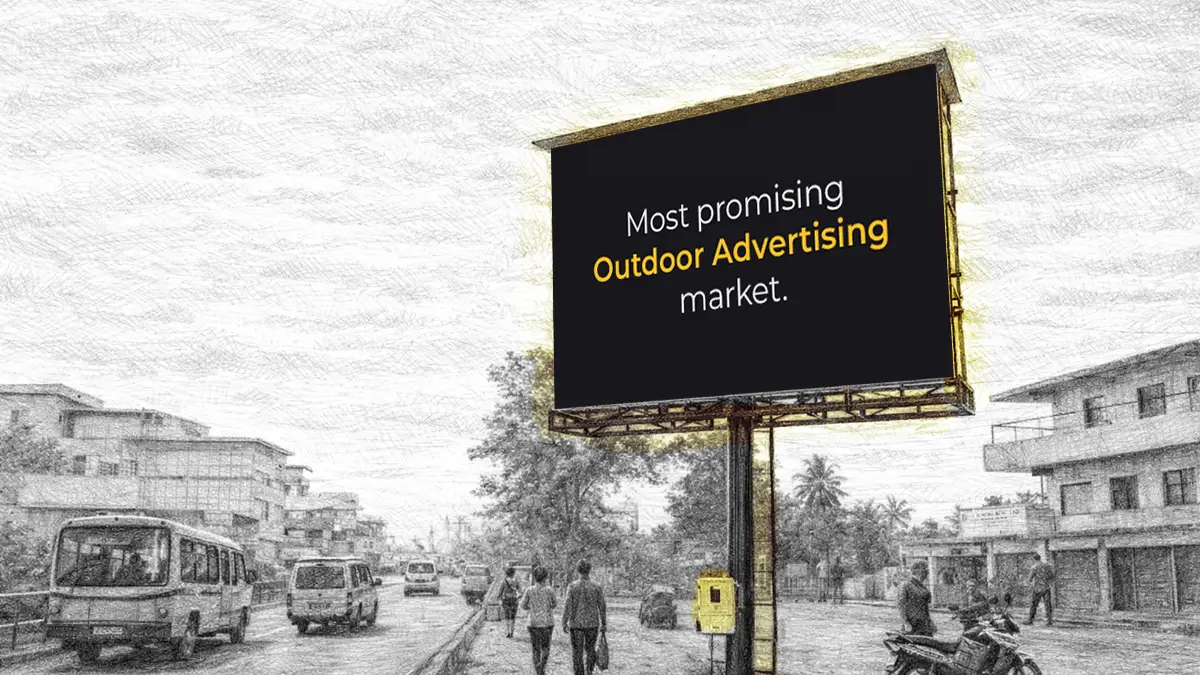
Kerala is one of the few Indian states where outdoor advertising reaches an audience that reads billboard creative, has the disposable income to act on it, and moves through concentrated urban corridors that make repeat exposure almost unavoidable. For brands and agencies planning outdoor advertising in Kerala, these structural advantages translate into campaign performance that most other Indian markets cannot match.
Yet most national media plans still treat Kerala as a secondary market — a line item in a south India buy. That gap between Kerala’s actual advertising potential and the attention it receives from media planners is closing fast. Here is what is driving the shift.
Kerala’s Consumer Profile Gives Outdoor Advertising Unusual Leverage
Kerala’s literacy rate — 96.2%, the highest in India — changes what outdoor advertising can accomplish. In markets with lower literacy, a billboard is primarily a visual stimulus: colours, logos, brand recall through repetition. In Kerala, a billboard is read. Headlines register. Body copy gets processed. Brand messaging lands with a precision that impression counts alone do not capture.
Layer on the NRI factor. Over 2 million Keralites currently work abroad, primarily in the Gulf states, with the total non-resident Keralite population reaching 4 million (Kerala Migration Survey, 2023). The remittance income flowing back creates a consumer profile with higher disposable income, stronger brand awareness, and more considered purchase behaviour than per-capita income figures suggest. A household receiving Gulf remittances shops differently — responding to premium positioning, quality signals, and brand reputation in ways that reward outdoor media’s permanence and visibility.
Kerala’s geography amplifies these advantages. The state is narrow — 560 km long but only 35–120 km wide (Government of Kerala) — with commercial activity concentrated along the NH-544 and NH-66 highway spines. Audiences do not disperse across wide urban grids the way they do in Delhi or Bangalore. The same commuters pass the same locations daily, and repeat exposure — the foundation of outdoor advertising effectiveness — happens naturally.
Three corridors illustrate this concentration:
- Kochi’s Edapally–Kakkanad stretch (NH-544): Kerala’s densest concentration of IT professionals, corporate offices, and retail. A screen on this route reaches the same high-value audience on every commute.
- Thrissur’s Swaraj Round and commercial core: The gold and textiles capital of Kerala. Footfall density relative to population is among the highest in the state.
- Kozhikode’s Mavoor Road: The commercial hub of Malabar, serving a distinct consumer demographic with different purchase rhythms.
The result: outdoor advertising in Kerala reaches an audience that reads creative, has the income to act on it, and moves through corridors where repeat exposure is almost unavoidable. For digital out-of-home specifically, fewer screens can deliver higher effective frequency — a campaign on five well-placed screens along a primary corridor outperforms fifteen scattered across secondary roads.
The Festival Economy Creates Predictable, High-Intensity Advertising Windows
Kerala’s retail calendar does not follow the national pattern. While most Indian advertising budgets peak around Diwali, Kerala’s largest retail season is Onam — a festival that builds across six to eight weeks through August and September. Jewellery, textiles, electronics, FMCG, and real estate all peak during this window. Brands that time their outdoor campaigns to this cycle capture audiences at their highest purchase intent.
But Onam is not the only window. Kerala’s advertising calendar has at least five distinct peaks:
Onam (August–September): Kerala’s largest retail season — jewellery, textiles, electronics, and FMCG brands compete across a six-to-eight week build-up.
Vishu (April): The second-largest retail window, anchored in gifting, electronics, and general retail.
Christmas and New Year (December–January): High commercial intensity in Kochi, Thrissur, and coastal towns — retail, tourism, and hospitality brands are especially active.
NRI Return Season (May–June, November–December): Concentrated demand in real estate, gold, luxury goods, and automotive — categories where remittance-funded purchase decisions cluster.
School Admissions (March–May): Education, coaching, and EdTech brands targeting a concentrated parent audience during peak decision season.
Each of these windows creates a concentrated demand spike where outdoor advertising performs at its strongest — audiences are actively shopping, brand recall drives immediate action, and screen locations along commercial corridors capture footfall at its peak.
National media plans built around a single Diwali-anchored calendar miss these windows entirely. A Kerala-specific outdoor strategy captures all five.
Why Digital Screens Are Gaining Ground in Kerala
Kerala’s outdoor advertising market has historically run on flex and vinyl hoardings. That is shifting — and for a market with five seasonal peaks, the reasons are structural. Digital screens let you swap creative for each festival window without a new print run or installation. One screen, one booking, five different campaigns across five seasons. Traditional hoardings would require five separate print runs, five installations, and five sets of permissions.
India’s DOOH segment is growing at roughly 20% year-on-year, and the national market is on track to cross ₹1,000 crore by 2026 (Adgully, 2025). Kerala — with its concentrated corridors, seasonal demand spikes, and high-quality audiences — is positioned to capture a disproportionate share of that growth.
We will publish a detailed, data-driven comparison of digital billboard vs traditional hoardings separately.
What This Means for Brands and Agencies Planning Kerala Campaigns
Kerala is not a difficult outdoor advertising market. It is a specific one — and the specificity works in your favour when you plan for it correctly.
High consumer literacy means your creative is read, not just glimpsed. NRI-driven purchasing power means your audience can act on what they see. Concentrated urban corridors mean fewer screens deliver higher frequency. And a festival calendar with five distinct peaks means there is always a high-intent window to target.
The brands and agencies seeing the best results from outdoor advertising in Kerala are the ones treating it as a distinct market — not an add-on to a national buy. They plan for Onam instead of Diwali. They select corridors instead of scattering screens. They use digital screens to adapt creative across seasons instead of locking into a single static message.
Kerala’s outdoor advertising market is not about to become India’s next big DOOH market. For the brands paying attention, it already is.
Planning a campaign? Contact our team to discuss screen availability and campaign strategy for your target corridors in Kerala.
Frequently Asked Questions
Why is Kerala a strong market for outdoor advertising?
Kerala combines India’s highest literacy rate (96.2%) with significant NRI remittance income, creating a consumer base that reads outdoor creative carefully and has the purchasing power to act on it. The state’s festival-driven retail economy — anchored by Onam, Vishu, and Christmas — generates concentrated advertising demand that rewards well-timed outdoor campaigns.
What makes digital billboards more effective than traditional hoardings in Kerala?
Digital screens allow multiple creatives per campaign, daypart scheduling, and rapid content changes — advantages that matter in a market where festival seasons shift buying behaviour week by week. Traditional hoardings require physical installation and cannot adapt to seasonal timing the way digital screens can.
When is the best time to run an outdoor advertising campaign in Kerala?
Onam season (August–September) is Kerala’s largest retail window, equivalent to Diwali in North India. Vishu (April), Christmas, and the NRI return seasons (May–June and November–December) are also high-impact windows. Campaigns should be booked 4–6 weeks before the season to secure premium locations.
How does Kerala’s audience differ from other Indian OOH markets?
Kerala’s 96.2% literacy rate means outdoor creative is read, not just seen. Combined with remittance-driven disposable income, this creates higher brand recall and stronger purchase intent per impression than markets with lower literacy and different income profiles.
Is outdoor advertising in Kerala effective for national brands?
Yes. National brands entering Kerala benefit from concentrated urban corridors along the NH-544 spine and high audience quality. However, campaigns must account for Kerala-specific variables — the festival calendar, regional language preferences, and distinct city-level audience profiles — to perform well.
Ready to advertise on digital screens in Kerala? Get in touch with our team to plan your campaign across Kerala’s highest-traffic corridors.