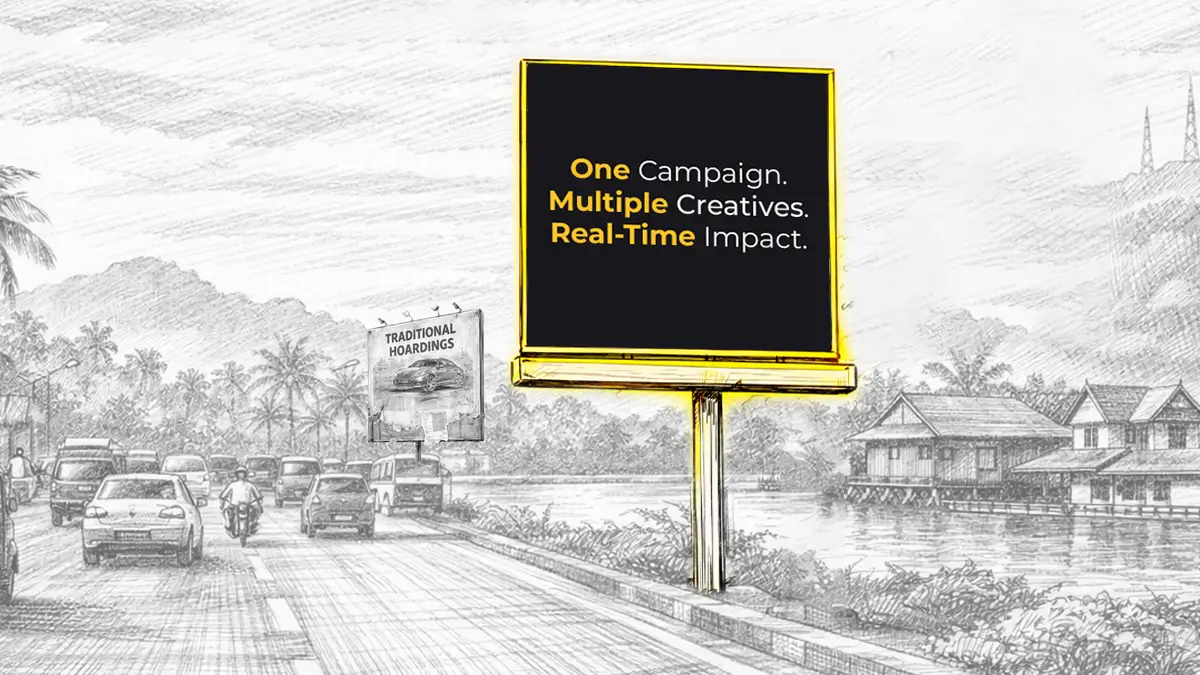
Digital billboards deliver 83% ad recall compared to 65% for static hoardings. Campaign creative changes in hours, not days. For brands and agencies choosing between a digital billboard vs traditional hoarding in Kerala, these are not marginal differences — they determine how a campaign performs.
The comparison is not a simple “digital wins.” Traditional hoardings still hold advantages in specific scenarios. The right choice depends on campaign objectives, not format loyalty. Here is what the data shows.
What the Research Shows: Recall, Flexibility, and Measurement
The recall gap
The strongest case for digital screens starts with recall data. Nielsen research conducted for the OAAA found that approximately 83% of people remembered seeing a digital billboard ad, compared to 65% for static displays. That 18-percentage-point gap means roughly one in five viewers who would miss a static message will remember a digital one.
It does not stop at recall. An OAAA and Harris Poll study found that among people who noticed a digital billboard, 65% took at least one action afterward — visiting a website, searching online, or walking into a store (OAAA/Harris Poll, 2023). The data across the key dimensions:
- Ad recall: ~83% for digital screens vs ~65% for static hoardings (Nielsen/OAAA)
- Post-exposure action: 65% of people who noticed a digital billboard took action — no comparable figure exists for traditional hoardings (OAAA/Harris Poll, 2023)
- Mobile follow-through: Over half of those actions happened on mobile (OAAA/Harris Poll, 2023)
- Motion creative uplift: Digital screens with motion creative produce more than 2× the recall of static formats (OAAA)
In Kerala’s context, these recall advantages compound. With a 96.2% literacy rate — the highest in India — outdoor creative gets read, not just glimpsed. A digital screen displaying a crisp, well-lit creative with motion elements captures more of that reading attention than a sun-faded vinyl hoarding.
Creative flexibility changes the game for seasonal markets
This is where the operational gap between digital and traditional becomes most apparent — particularly in a market like Kerala with five distinct advertising seasons.
A traditional hoarding requires a new print run for every creative change. Printing, transporting, and installing a flex or vinyl hoarding typically takes 3-5 days. For a campaign running through Onam (August-September) that needs to transition into a festive sale and then a post-Onam creative, that means three separate production cycles, three installations, and three sets of municipal permissions.
A digital screen changes creative in hours. The same screen booking can run:
- An Onam teaser in early August
- A peak-season promotional creative in late August
- A post-Onam clearance message in September
- A Dussehra or pre-NRI season creative in October
One booking. Four creatives. Zero physical production. No installation downtime.
For agencies managing multi-brand Kerala campaigns across Kochi, Thrissur, and Kozhikode, this operational efficiency eliminates the logistics of coordinating print vendors, installation crews, and municipal approvals across multiple cities.
Digital screens also enable daypart scheduling — running different creatives at different times of day. A restaurant chain can promote lunch specials from 11 AM to 2 PM and dinner offers from 5 PM to 9 PM on the same screen. Traditional hoardings show one message, 24 hours a day, regardless of when the audience is most receptive.
Measurement and proof of performance
Accountability is where the digital billboard vs traditional hoarding gap becomes hardest to ignore — especially for agency planners presenting post-campaign reports to clients.
Digital screens generate proof-of-play reports — verified logs confirming exactly when an ad appeared, for how long, and how many times. Auditable data, ready for the client deck.
Traditional hoardings offer none of this. A brand pays for 30 days and gets an estimated footfall figure from a traffic survey — often months old — and a photograph of the installed board. Nobody confirms the hoarding was:
- Visible throughout the booking period (tree growth and construction obstruct boards regularly)
- Undamaged (rain, wind, and sun degrade vinyl fast in Kerala’s climate)
- Displaying the correct creative (installation errors do happen)
The difference in what you can actually report:
- Proof of play: Digital screens log every ad display automatically, with timestamps. Traditional hoardings have no equivalent.
- Impression data: Digital campaigns use real-time footfall data. Traditional hoardings rely on periodic traffic surveys — often months or years old.
- Creative verification: Digital screen campaigns can be monitored remotely. A traditional hoarding requires a physical site visit to confirm it is intact and displaying correctly.
- Campaign reporting: Digital campaigns produce exportable data — dates, times, frequency counts — for post-campaign analysis. Traditional hoardings deliver a photograph and an estimated reach figure.
- Multi-creative tracking: When rotating ads on a digital screen, each creative gets its own performance breakdown. A traditional hoarding runs one message with no data.
The practical difference: “we estimate your ad reached approximately 50,000 people” versus “your ad displayed 4,200 times across 14 days, with peak exposure between 8–10 AM and 5–7 PM on weekdays.”
Where Traditional Hoardings Still Win
The data does not make traditional hoardings obsolete. They remain the right choice in specific scenarios:
Long-duration, single-message campaigns. If a brand runs the same creative for 6-12 months — a real estate project under construction, an educational institution’s annual branding — a hoarding’s lower cost and permanence make it more efficient. No creative to rotate, no daypart advantage to exploit.
Semi-urban and rural locations. Digital screen infrastructure concentrates in urban corridors. In Kerala’s tier-2 and tier-3 towns — Palakkad, Alappuzha, Pathanamthitta — traditional hoardings remain the primary outdoor format. A brand targeting these markets has no digital alternative in many locations.
Budget-constrained, single-location campaigns. Static hoardings cost significantly less for a single placement. A local business that needs one visible location for brand awareness, with no creative changes planned, will find traditional hoardings more cost-efficient on a per-location basis.
24-hour visibility without power dependency. Traditional hoardings — when backlit — do not depend on power supply or digital infrastructure. In areas with unreliable electricity, they offer consistent visibility that a digital screen cannot guarantee without backup power.
The honest assessment: traditional hoardings are not a worse format. They are a different tool, optimised for different campaign requirements.
How to Decide for Your Kerala Campaign
India’s OOH advertising market tops Rs 6,500 crore, but DOOH currently accounts for only about 12% of that total — compared to 40% in the United States and 90% in China, according to data reported by Adgully and Adonmo (2024). That gap narrows fast. DOOH in India grows at 70% year-on-year, while static OOH grows at 10-15%.
For Kerala, this trajectory matters. As digital screen networks expand beyond Kochi and Thiruvananthapuram into Thrissur, Kozhikode, and Kannur, the format question shifts from “if digital” to “how much digital” in every media plan.
The digital billboard vs traditional hoarding decision is strategic, not ideological. Here is how to evaluate it for a Kerala campaign:
Choose digital screens when:
- You need multiple creatives or seasonal rotation — Onam teaser, peak creative, post-season clearance
- Your agency needs post-campaign reporting and proof of play
- You are coordinating a multi-city plan across Kochi, Thrissur, and Kozhikode
- The campaign window aligns with a festival season
Choose traditional hoardings when:
- You are running a single creative for three months or more with no planned changes
- Your target locations are in tier-2 or rural Kerala where digital screen infrastructure is limited
- Budget favours a single long-term placement over rotating digital inventory
For a single high-traffic junction, either format can work — availability and campaign objective determine the call.
The most effective Kerala campaigns increasingly use both — digital screens in primary urban corridors for high-frequency, high-recall impact, and traditional hoardings in secondary locations for extended brand visibility at lower cost.
Planning an outdoor campaign in Kerala? Talk to our team about screen availability and campaign strategy for your target markets.
Frequently Asked Questions
Do digital billboards get higher recall than traditional hoardings?
Yes. Nielsen research conducted for the OAAA found that approximately 83% of viewers recalled seeing a digital billboard ad, compared to 65% for static displays. Separate OAAA research confirmed that digital billboards with motion graphics yield more than 2x higher ad recall than static formats.
Are digital billboards worth the higher cost compared to hoardings?
For campaigns that need creative flexibility, seasonal adaptation, or measurable performance, digital screens deliver more value per rupee despite higher upfront rates. A single digital screen booking can run multiple creatives across different dayparts and seasons — work that would require separate print runs, installations, and permissions with traditional hoardings.
Can traditional hoardings still be effective for advertising in Kerala?
Traditional hoardings remain effective for long-duration, single-message campaigns where the creative does not need to change. They cost less upfront and work well in semi-urban and rural locations where digital infrastructure is limited. The choice depends on campaign objectives, not a blanket preference.
How does digital outdoor advertising measurement compare to traditional hoardings?
Digital screens provide proof-of-play reports confirming exactly when and how often an ad was displayed. Traditional hoardings rely on estimated footfall and traffic counts with no verification that the hoarding was visible, undamaged, or unobstructed during the campaign period.
What percentage of India’s OOH market is digital?
DOOH currently represents approximately 12% of India’s OOH advertising market, which tops Rs 6,500 crore. DOOH grows at 70% year-on-year compared to 10-15% for static OOH, according to industry data reported by Adgully.
Ready to compare digital screen locations for your next Kerala campaign? Contact our team to discuss corridor options and campaign planning.