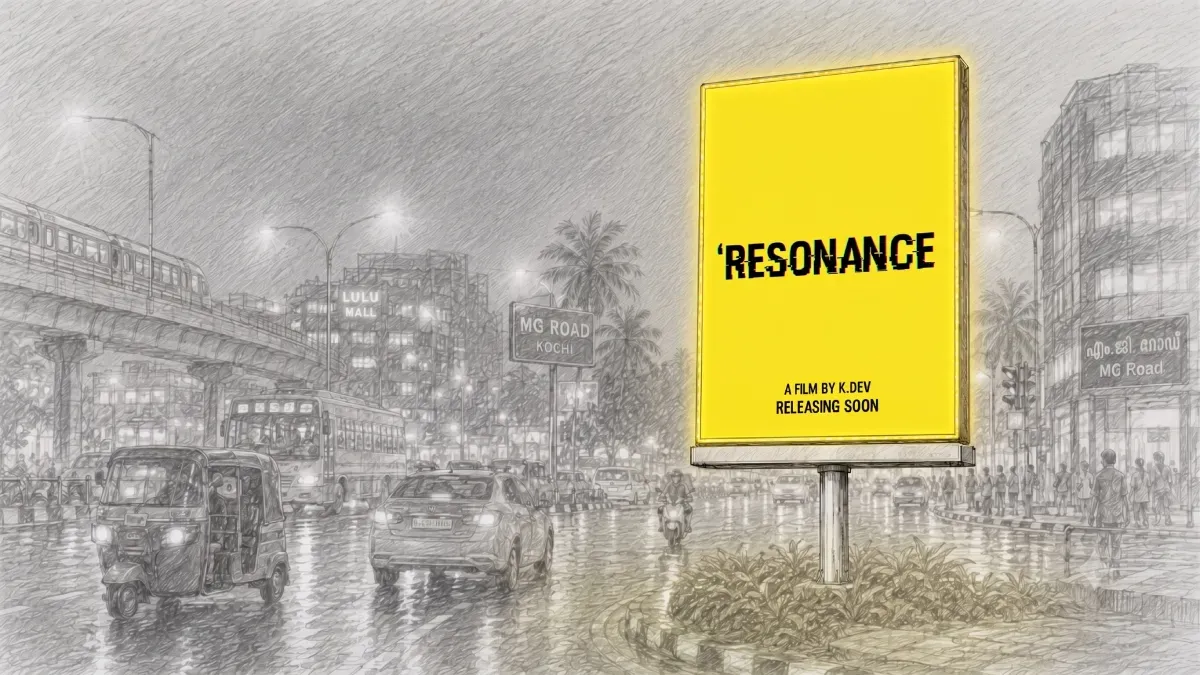
Mollywood releases roughly four films every week. Against that release density, movie advertising in Kerala has one decisive problem: audiences need to have already formed an opinion about your film before the booking app opens on Friday morning. Most release campaigns solve this too late.
Mollywood releases 216 films a year. The opening weekend decides most of them.
216 films competed for Kerala’s screens in 2025, down from 229 in 2024. The state runs 722 cinema screens across 367 complexes:
- Ernakulam: 108 screens
- Thiruvananthapuram: 96 screens
- Thrissur: 83 screens
That means Friday-to-Sunday collections decide whether a film holds its screens or exits early. For a production without a franchise or a major star, the question isn’t whether the campaign spent enough; it’s whether audiences had already mentally shortlisted the film before they opened a booking app.
Insight: The opening weekend is won or lost in the three weeks before it, not the campaign week itself.
Why DOOH does what a film’s digital stack cannot
Every film’s trailer is on YouTube. Every release is running social ads. Every production is competing for the same scroll the week before release.
Digital-only campaign
- Reaches people who are already in a choosing mindset
- Competes with every other ad in the same feed
- Gets skipped, muted, or blocked before it registers
DOOH on Kerala’s commercial corridors
- Reaches people during commutes, before they’re choosing anything
- No skip button, no feed, no algorithm deciding whether to show it
- Builds familiarity over weeks, not impressions
A commuter passes a screen in Ernakulam’s commercial area on a Tuesday morning, three weeks before release. They’re not deciding anything. But that exposure registers. When they open BookMyShow on Friday, one title already looks familiar. Familiar wins.
A skip button cannot build ambient recognition. Three weeks of DOOH exposure on Kerala’s commercial corridors can. US research supports the pattern: a five-year study by Clear Channel Outdoor and Kantar found OOH outperforms digital, CTV, and television on ad awareness, brand favourability, and purchase intent.
What DOOH in Kerala’s commercial centers actually delivers
Kerala has 722 cinema screens distributed across the state; the film-going audience follows that distribution. DOOH in Kerala’s commercial areas is density and repeated exposure with a high-footfall audience over multiple weeks, not screen coverage.
LDX screens across Kerala’s commercial towns, from Thiruvananthapuram and Kollam in the south to Ernakulam and Kannur in the north, carry high daily footfall from working professionals, shoppers, and commuters. A film running on these screens gets repeated exposure from the same audience across three to four weeks, in a media environment with no skip button and no competing scroll. That is a different kind of reach from digital, not a replacement for it, and it works best when the digital campaign is already running alongside it.
Book four weeks out. Brief motion creative from the start.
Productions getting the most from pre-release DOOH advertising treat outdoor as a distinct phase, not a simultaneous activation alongside digital. The timing decision comes first: activate three to four weeks before release to secure screen positions in your film’s key markets before competing productions do. The awareness window is the weeks before the booking decision, not the campaign week. But lead time only works if the creative is ready. Going live with a generic poster three weeks out is less effective than strong motion creative launched a week earlier.
Brief motion creative as a distinct deliverable, not a poster adaptation. Movement catches attention in commercial environments where static images blend into surrounding visual noise. If it is briefed as an afterthought once the print campaign is finalised, it will read as one.
The film that’s already familiar wins Friday
Pre-release movie advertising in Kerala works when it builds familiarity in the physical environment: before the multiplex listings go live, before anyone is actively choosing.
If you are planning a release in Kerala, talk to the LDX Media team about pre-release outdoor.
Frequently Asked Questions
How far in advance should film productions book outdoor advertising for a Kerala release?
Three to four weeks before release. Productions booking in the final week work with whatever positions remain. In competitive periods (festival weeks, long weekends), premium positions in high-demand markets fill earlier than that.
Can a smaller production with a limited outdoor budget still get meaningful reach in Kerala?
Yes, but the strategy shifts. A smaller budget works best when it follows the film’s audience rather than trying to cover the state. If the cast, story, or production has a strong association with a specific district or city, concentrating outdoor spend there, where the film already has word-of-mouth advantage, outperforms spreading the same budget thinly across multiple markets. Fewer screens with strong motion creative and a full three-to-four week run typically outperform a broader buy with static assets and a one-week window. The timing advantage costs nothing extra; it just requires planning ahead.
Does outdoor advertising improve box office performance for Malayalam films?
Research supports the connection. A five-year US study by Clear Channel Outdoor and Kantar found OOH outperforms digital, CTV, and television on ad awareness, brand favourability, and purchase intent. Pre-release outdoor builds the ambient recognition that turns browsing intent into a Friday booking.
What creative formats work best for film advertising on digital outdoor screens?
Brief it as a separate deliverable with its own spec: landscape format and movement rather than a zoomed or panning static. Hand it to your creative team at the same time as the key art brief, not after. A motion brief written in parallel takes the same creative effort; one written after the print campaign is done produces an animated poster, not a screen-native creative.
How does DOOH fit alongside a film’s digital marketing campaign?
DOOH doesn’t replace the digital campaign; it extends it into the physical environment. Once the trailer is out and the film’s identity is in circulation online, outdoor keeps it present during commutes and at commercial intersections. A viewer who has already watched the trailer on YouTube encounters the same film on a DOOH screen the next morning; that repetition across environments builds recognition that a single-channel campaign cannot.
Malayalam film campaigns that book four weeks out have better screen positions available than those that arrive in the final week. If your release date is set, talk to the LDX Media team about which corridors matter for your film’s audience. Pre-release positions in the right markets fill before the campaign week.