Why Most Multi-Channel Campaigns Get DOOH Advertising Wrong
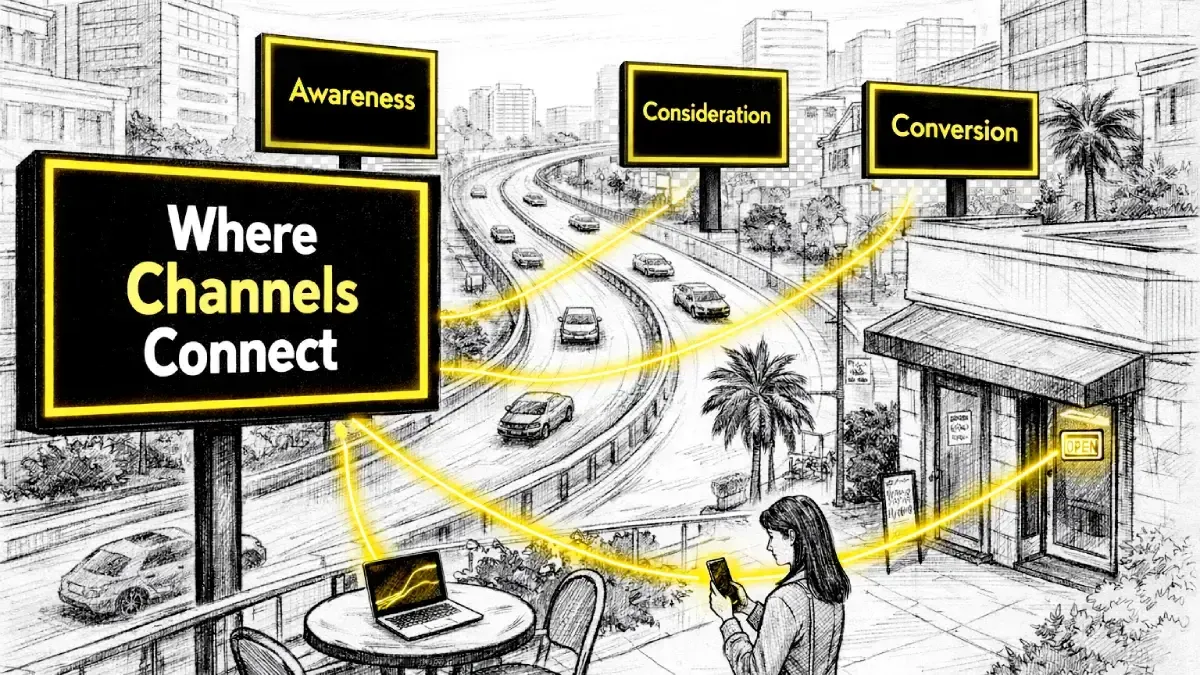
Most media plans activate DOOH advertising and digital channels simultaneously: budget split, creative adapted, everything launching together. That’s the wrong sequence. Ocean Outdoor’s neuroscience research shows the priming effect is directional: audiences who see DOOH first show measurably stronger brain-level engagement when they later encounter the same brand on social media. Run them concurrently and you get some uplift. Run DOOH first and you get materially more of it.
Most media plans sequence DOOH wrong
The standard brief treats DOOH as a reach channel and activates it alongside everything else. The rationale is straightforward: maximise impressions during the campaign window, coordinate messaging across all touchpoints, go live together. But this approach misunderstands what DOOH actually does to a media plan.
DOOH’s value is not reach volume. It’s recognition formation: building a brand signal in the physical environment before a consumer encounters the brand on a screen. That recognition is what produces the mobile engagement uplift. Without prior exposure, the mobile ad is an introduction; with it, the mobile ad is a follow-up. Those are fundamentally different commercial situations.
The OAAA consumer study (US, Out of Home Advertising Association of America) found 73% of consumers view DOOH ads favourably, compared to 50% for television and 48% for social media. That favourability gap comes from how DOOH lands: ambient, no skip button, no inbox, non-interruptive by design. Recognition built over repeated encounters feels different from an ad that interrupts your feed. But accumulated recognition only becomes commercially useful if the digital campaign that follows it arrives after the physical exposure, not beside it.
Concurrent activation is the most common DOOH deployment and the least effective. The campaigns extracting measurable uplift are sequencing physical ahead of digital, not treating them as parallel channels.
Physical priming before digital activation: what the neuroscience shows
The priming mechanism is specific. A consumer sees a brand on a physical screen, a digital billboard on a commercial corridor or a screen outside a shopping centre, in a context where they’re not already in purchase mode. The exposure is ambient. There is no call to action, no conversion pressure. The brand registers as familiar.
Weeks later, a Meta ad for the same brand appears in their feed. The recognition from the physical exposure changes how they respond. Ocean Outdoor’s fifth neuroscience study, conducted with Neuro-Insight using brain imaging on 138 participants across London and Manchester, found that audiences who had seen DOOH first showed an 87% higher brand approach response when they subsequently encountered the same brand on social media, compared to audiences with no prior DOOH exposure. Outsmart, the UK OOH industry body, found a 38% uplift in short-term mobile actions for better-performing OOH campaigns running alongside digital.
The priming effect is measurable at the brain level before it shows up in click-through data. OOH amplifies mobile performance even in concurrent deployments. But Ocean Outdoor’s brain-imaging data shows that sequencing physical exposure ahead of digital produces materially stronger engagement responses.
These effects aren’t additive reach benefits. They’re a sequential mechanism. The campaign stack, in the order that produces them:
- DOOH builds brand recognition in the physical environment
- Digital channels activate against audiences already holding that recognition
- Search and social convert intent that recognition has already formed
Each stage is measurably weaker without the one before it. That’s what makes sequencing a strategic decision rather than a scheduling preference.
Why Kerala’s concentrated screen geography makes this sequencing more measurable than most markets
Kerala’s DOOH coverage is still concentrated rather than fragmented. That’s a structural advantage for sequenced campaigns that most national planners underestimate.
In markets with dispersed screen distribution, building a reliable retargeting pool from DOOH-exposed audiences is difficult. You can’t geofence an entire metro. In Kerala, screen concentration across Kochi’s commercial districts, Thiruvananthapuram city, and Kozhikode means physical exposure is predictable and clustered. You can build a geofence retargeting pool around specific screen locations and activate mobile campaigns against audiences who have demonstrably been within exposure range. The sequencing is not theoretical. It’s executable today with the screen network that exists.
Concentrated screen geography is a measurability advantage. Kerala’s network is small enough to geofence accurately, unlike most Indian metro markets, which have hundreds of screens spread across large areas.
This maps directly onto Kerala’s seasonal advertising calendar. An Onam campaign that activates DOOH screens in early July, before competitor digital spend begins, is reaching audiences when the brand field is still quiet. By the time retargeting campaigns launch in late July, those audiences carry physical brand recognition into their social feeds. The digital campaign reinforces. It doesn’t have to introduce.
The same logic holds for NRI season windows, when returning Non-Resident Keralites are in-market in significant numbers. High-footfall corridors in Kochi and Thrissur during these windows carry commercially dense audiences for categories that consistently move in these periods:
- Real estate: families returning to invest in property or land
- Gold and jewellery: high-value purchases timed to homecoming
- Consumer durables: appliances and electronics for refitted homes
India’s DOOH market is growing at a 16.5% CAGR, according to PwC’s India Entertainment and Media Outlook 2025–29, with its share of total OOH spend projected to reach 44.1% by 2029. Kerala’s concentrated network is an advantage for sequenced campaigns right now. As coverage scales, that advantage diffuses into the broader market.
The window where Kerala’s screen concentration makes geofence sequencing this reliable is finite. It narrows as the medium grows.
The brief change that fixes the sequence
One structural change fixes the problem: DOOH goes in the plan four weeks before Meta and Google activation, not concurrent with it.
Creative must be consistent across both formats. The priming effect requires visual recognition: the same brand identity and campaign visual that appears on the physical screen needs to follow the consumer into their social feed. Running different creative for OOH and digital breaks the recognition chain and eliminates the uplift. The brief to the creative team should specify consistent visual language across both environments as a campaign requirement, not a nice-to-have.
For Kerala-specific timing:
- Onam: Book DOOH from early July. Digital activation from late July. By the time competitor digital spend peaks in August, the physical priming window has already closed.
- NRI seasons: DOOH from the first week of May and November–December (the Christmas homecoming window), ahead of the retail surge in each window.
- Product launches: Four-week DOOH lead before any Meta or search activation.
One practical implication: premium DOOH positions in Kochi fill before peak season. Agencies planning a Kerala campaign in August for Onam work with secondary locations, and secondary locations produce weaker audience clustering for geofence retargeting. The sequencing strategy only works with inventory that produces reliable physical exposure. The brief needs to arrive before the season, not with it.
How the technology makes sequencing measurable
Impression-to-engagement sequencing is now a trackable campaign architecture, not just a planning principle.
Three technology layers make it measurable:
- Geofence retargeting identifies mobile devices within a defined radius of a DOOH screen during its active flight and adds them to a retargeting audience for subsequent mobile and social campaigns. In Kerala’s concentrated screen geography, geofencing a handful of high-concentration screen locations builds a meaningful retargeting pool, without the data sparsity problem that affects larger, more distributed networks.
- Post-campaign attribution via mobile signal overlap measures brand lift by comparing the behaviour of exposed versus unexposed audiences after the campaign period: search volume, website visits, store visits. This is how the Outsmart and Ocean Outdoor research translates into market-specific results rather than remaining external claims.
- DV360 integration allows audience overlap analysis for brands running programmatic video alongside OOH, identifying where DOOH-exposed audiences intersect with programmatic digital audiences to measure reach extension versus duplication.
The DOOH media buy provides the physical audience anchor that activates these tools. Geofence retargeting and attribution run on the agency’s technology stack, using screen location data as the input.
The measurement gap between a physical screen impression and a recorded conversion is real. pDOOH and geofence retargeting close it incrementally: not perfectly, but enough to demonstrate that the digital spend running after DOOH performs differently from digital spend running alone. That’s the metric worth building toward.
The sequence is the strategy
Most multi-channel plans treat DOOH as a parallel channel. The research is consistent: it functions as a prerequisite. The brands and agencies seeing measurable returns from Kerala campaigns are activating screens first, then building digital campaigns against audiences who have already encountered the brand in the physical environment.
The measurement is not perfect yet. The amplification is real.
If you’re planning a multi-channel campaign for a Kerala launch, a seasonal push, or an NRI-season window and want to understand where DOOH belongs in the sequence, talk to the LDX Media team. The brief needs to arrive before the season does.
Frequently asked questions
What is DOOH advertising and how does it differ from traditional OOH?
DOOH (Digital Out-of-Home) advertising uses digital screens in public spaces to display ads, unlike traditional OOH which uses static printed hoardings. DOOH allows for dynamic, time-targeted content, real-time updates, and programmatic buying. In India, DOOH accounted for 28.8% of total OOH spend in 2024, according to PwC’s India Entertainment and Media Outlook 2025–29, and is projected to reach 44.1% by 2029.
Does adding DOOH to a campaign actually improve digital ad performance?
Yes, but the timing of the sequence matters more than most briefs acknowledge. A practical check: if your DOOH flight ended less than two weeks before your digital launch, the priming window was probably too short for meaningful recognition to accumulate. The neuroscience research points to ambient exposure over multiple encounters, not a single impression the week before. For seasonal campaigns, the working rule is a minimum four-week DOOH lead before digital activation begins. If the brief arrives after that window has closed, the campaign runs concurrent rather than sequential, and the amplification effect is weaker.
Where in the campaign funnel does DOOH advertising work best?
DOOH is strongest at the top of the funnel, building awareness before a purchase window opens. For seasonal campaigns, activate DOOH 4 weeks ahead of peak digital spend, then launch Meta and Google campaigns against audiences already primed by physical exposure. By the time your search campaigns go live, the brand recognition work is already done.
How does DOOH advertising work alongside social media and search campaigns?
DOOH reaches people in physical space before they’re in purchase mode. Digital channels then activate against audiences carrying that recognition. The ambient exposure from a physical screen changes how someone responds to the same brand in their social feed. The mobile ad becomes a follow-up rather than an introduction. Coordinated creative across both formats is essential; the recognition effect only works when the visual language matches.
Planning a multi-channel campaign in Kerala? Talk to the LDX Media team about where DOOH belongs in the sequence.